
PARIS TEXAS: In The Middle Of The Road
An essay by Tom Oliver

“A person's life purpose is nothing more than to rediscover, through the detours of art or love or passionate work, those one or two images in the presence of which their heart first opened.” - Albert Camus
"The dust has come to stay. You may stay or pass on through or whatever." - bar sign in Paris, Texas
The first, and most lasting impression of Paris, Texas is distance. Ry Cooder's opening score, an eerie harmonic drone and haunting slide guitar, sounds like a faraway wind, gliding through shimmering open heat. The first few shots are an eagle-eyed view high up off the ground, both vacant and dreamlike. Below us is Harry Dean Stanton's nameless wanderer, alone in the desert.
A red cap hides his bearded, heat-struck face, a face that has been weathered and scarred into anonymity. He regards the endless landscape before him with neither fear nor ambition. Though we might presume some determination, his walk is without purpose.
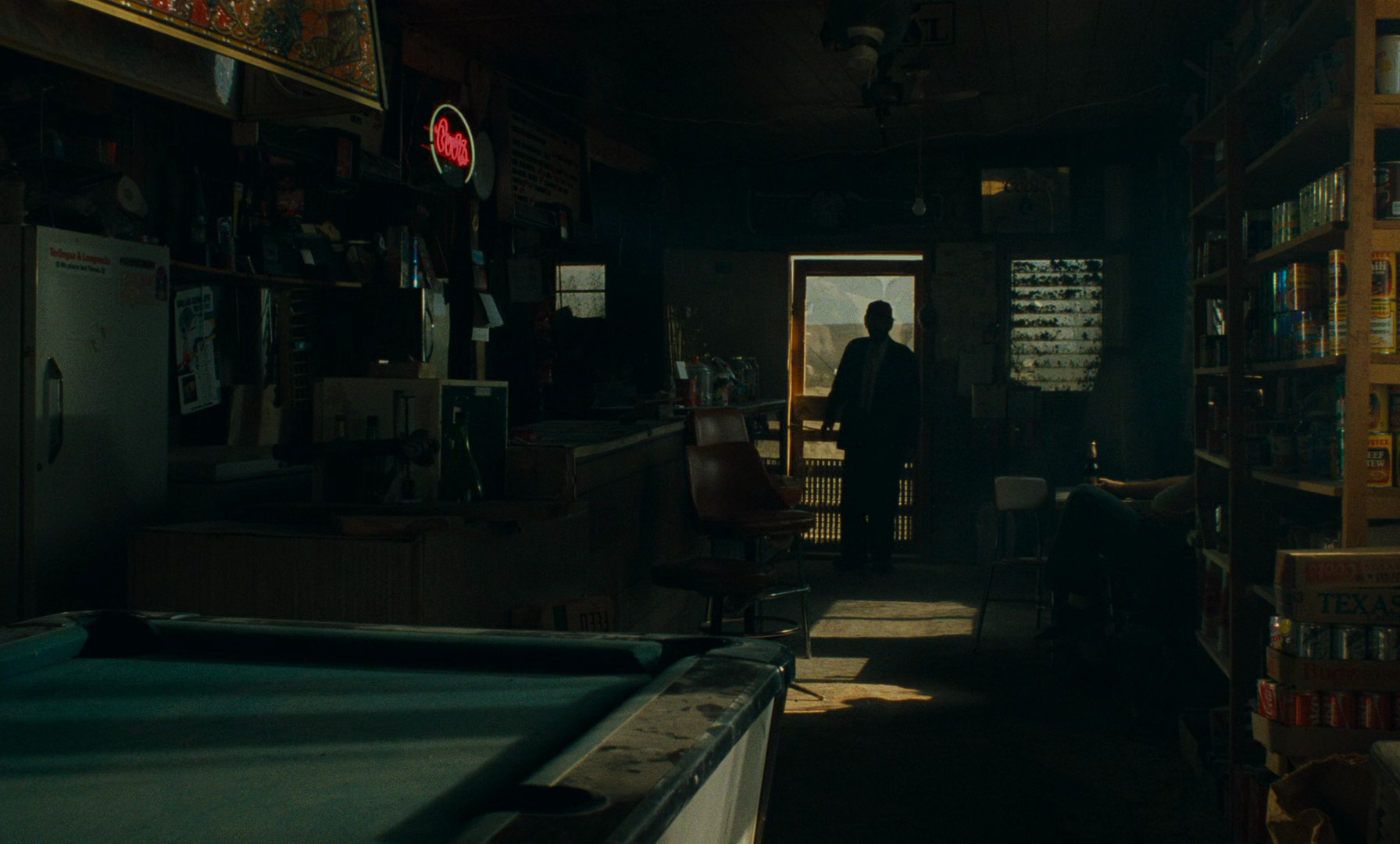
He enters a ramshackle structure, a dilapidated site struck far away from roads or lights or any links to civilisation. Inside is the vaguest sketch of a bar, determined by the faintest vibration of life that hums in the background; a wheezy radio grinds out an accordion melody, muted shafts of light creeping through muddied windows, a faceless figure in the back empties a beer bottle.
This is a purgatory, a state where there are no demands to either do or be, but to simply exist. A never-ending here-nor-there. And, only when this nameless wanderer finally collapses from exhaustion, and finds himself facing a more definitive status in death, does he become resurrected, and here he starts a journey back to a road he turned off from forever ago.
Those who anoint Paris, Texas as their favourite film of all time (among whom I include myself) recognise that it has a quality which elevates the film beyond mere canonisation. It won’t wash to simply rank it above other films. Instead, it must be acknowledged that this, for one reason or another, is one of those rare experiences in life that cannot be found elsewhere.
The Cannes Jury of 1984 knew it. A notoriously mercurial group often given to in-fighting and gatekeepery, they found a rare unanimity in awarding the film the festival’s coveted Palme d’Or. The film even impressed the much more discerning International Critics Circle, who also awarded it their FIPRESCI prize.
On initial release, it went on to modest success, mostly popular among art students and international film enthusiasts. Academic inquirers made lemonade out of the film’s transatlantic cross-pollination, a trait to which the film owes much of its early commendation.
A French/German co-production entirely in the English language. Directed by a German but written by a native Californian. Its male lead, a veteran character actor of new Hollywood in his late fifties, opposite the twenty-three-year-old daughter of Europe’s fiercest and most infamous film star. Even the title promised some form of international exchange, a promise rewarded by the film’s cold, sober view of an American landscape under the Reagan-era conservative overhaul.
The film is now close to forty years in distance from the socioeconomic climate in which it materialised, and has yet to lose any of its potency. It has, in fact, arguably deepened with age. The texture of the film gleams with the nostalgic warmth and simplicity of analogue lives, a washed-out colour that is made ever more vivid in a ruthlessly compartmentalised digital age. More than a few still burn a candle for a time before we allowed our public selves full and unmeasured global encroachment through our online presence, and perhaps Paris, Texas embodies a cry-for-help for a social culture in crisis.
Similar to how reported ghost sightings were rampant during the Second World War, as devastated nations outpoured their collective mourning into the novelty of seances and spirit mediums, or how reported UFO sightings in the US were at their peak during the space race of the early 60s, we unconsciously recognise rare phenomena which helps us understand the parameters of our ever-changing world. Through Paris, Texas, we can envision the freedom of anonymity, a state almost unimaginable in a social climate beset by self-perpetuating public prominence. Elsewhere, the film’s evocation of a deep yearning for intimacy and connection seems all too real against an increasingly self-involved, neoliberalist way of life.
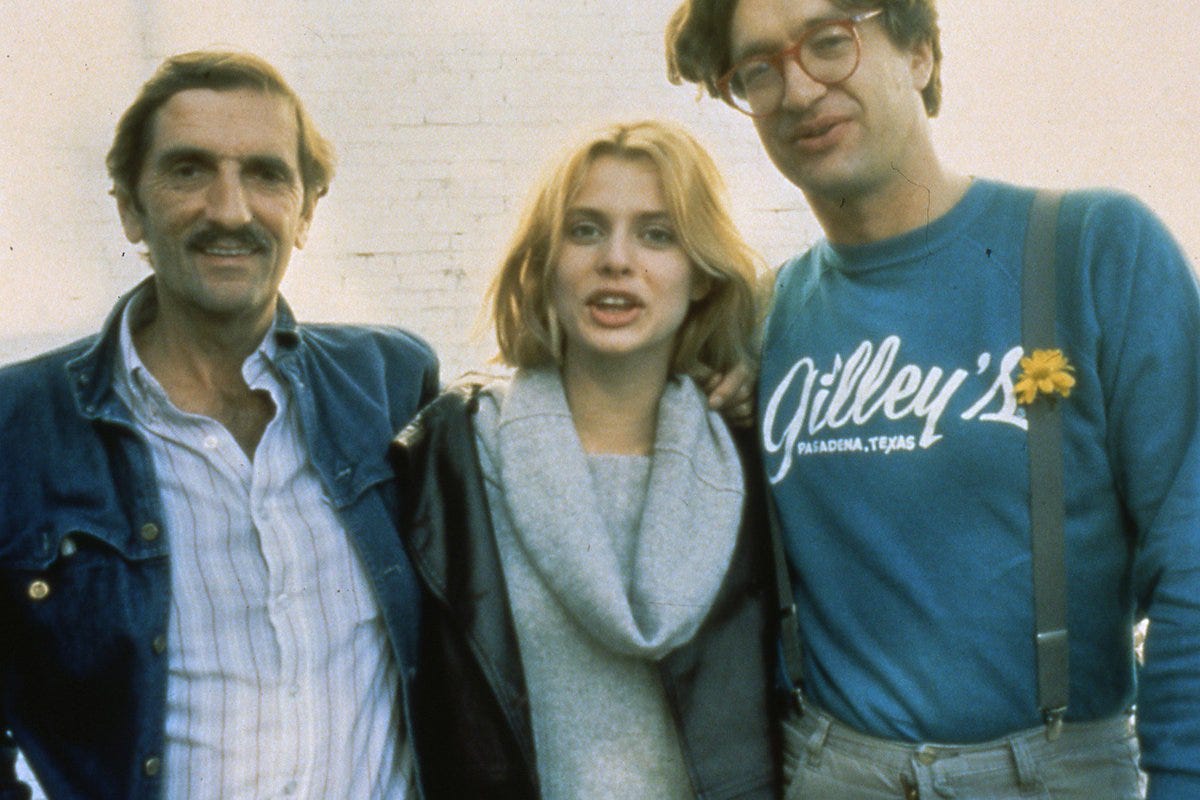
There are, then, analytic readings that offer a clearer context for why we might feel a certain way about the film. But there is also a deeper, more spiritual component at work, two very distant but complementary sides that urge at one another. Both director Wim Wenders and playwright/screenwriter Sam Shepard arrived at Paris, Texas at drastically different ends, but it was this elusive quality that drew them both together.
Wenders was born in Dusseldorf in 1945 to devoutly Catholic parents, and would later recall growing up in an era of great shame for Germany, a land that “had been stripped of memory, that black hole behind. Even as a child you sense it,” He remarked. “And nobody tells you what it is but you realise, why is there so little joy and why the heck do we not have a past?”. He read Faulkner, watched John Ford Westerns and listened to 50s rockabilly exclusively. He became convinced of ”a legendary place called America, a place where all good things came from.”
Shepard, conversely, suffered an all-too-typical American upbringing. Born in Illinois to an alcoholic Army Officer father and a teacher mother, he had a fairly nomadic upbringing on several army bases before the family settled on Duarte, California. As a teenager in the 60s, he acted and wrote poetry, as well as working as a stable hand on a nearby ranch. These disparate experiences gave him a skewed view of American tradition, an outlook he would channel into his plays, often stoic melodramas that dealt with broken idealism and flawed American archetypes.
Whereas Wenders looked fondly on the optimism of America from the vantage point of a faded European power, Shepard saw the cracks that ran through these romantic visions. The two were natural friends and mutual admirers, and began working on Paris, Texas throughout 1982, using Shepard’s own short story collection Motel Chronicles as a starting point.
The story started as something of a haggard myth: A amnesiac drifter by the name of Travis wanders aimlessly along the Texan desert. He collapses in the middle of nowhere and is picked up from a small town by his brother Walt. He doesn’t speak or eat. As he and Walt drive home to Los Angeles, a sense of the world around him starts to re-emerge, and he sets about reconnecting with his young son and reuniting them both with his long-gone wife, Jane.
This type of expansive but delicate storytelling was business as usual for both Wenders and Shepard. But, as production moved along, and the ever-elusive ending started to take shape, Wim acknowledged that they had something “that would truly move people”
In any other hands, at any other point in time, this may have been a compelling, if not memorable, piece of independent filmmaking. But both filmmakers worked within a simple but profound dialectic that lay at the heart of this story, and indeed all great stories: Our lives are inherently contradictory, our desires and actions never truly reconciled and our feelings often vague and paradoxical.
Most entries in the “all-time great films” canon are indeed indebted to this contradiction.
The eternally-exalted Citizen Kane, for example, is famed for its grand arching narrative which chronicles the life of an American primitive, himself archetypal for all-encompassing themes of power, corruption, mass media, megalomania and self-destruction. While its autocratic storytelling is lavished with innovative depth-of-field techniques and editing sleight of hand, the film wins the heart and not the head of film scholars both past and future by focusing on a sad young boy clinging desperately to the promise of innocence.
Vertigo, similarly, is Hitchcock’s own acknowledgement that the patient and exacting thrillers with which he made his name were ultimately human follies, and even the most reasonable and straight-laced of his detective heroes (and indeed, his own stringent storytelling techniques) are still susceptible to wayward madness.
Getting this balance right is a precarious high wire act that very few have successfully achieved. Those who do so often do it by accident, and those who are determined to get there by force often sacrifice any immediate recognition of their accomplishments. Paris, Texas achieves this harmony, and manages to do so in the most elemental sense.
At two hours and twenty minutes, the film is long, yet for all its moments of longing, it never drags. No moment sits for longer than it ought, or wrings too much out too soon, and yet so much of the film is open space, proper time in which to process. It is poignant and reflective in tone, but also adventurous and masterfully delicate with its lighter moments.
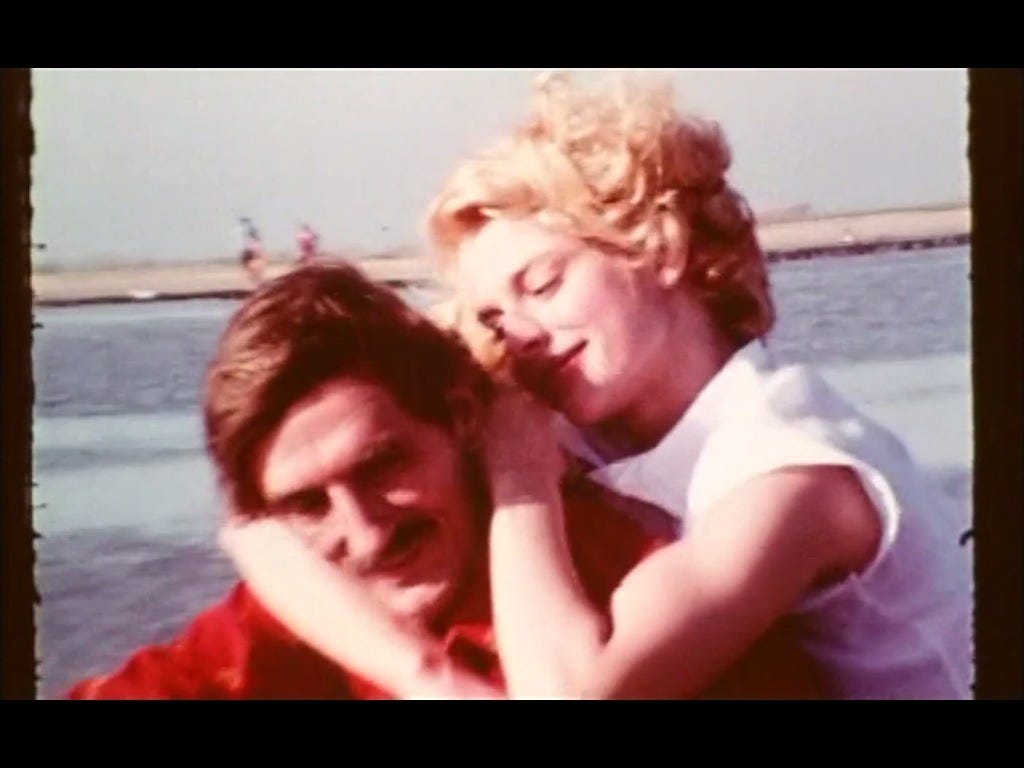
The super 8 scene of the film is perhaps the most complete distillation of this mode. Not only does it serve several ingenious narrative functions, introducing us indirectly to Nastassja Kinski's Jane, showing us Travis’ inner turmoil and bringing Hunter closer to his father, but it also holds an unseen thematic depth.
In the scene, Travis, Walt, Anne and Hunter watch a Super 8 film of the two families together on a beach day-out. The shots are small fragments of memory, old film whose colour has been washed out with time, no diegetic sound to provide context, only Ry Cooder's lilting rendition of Mexican traditional Cancion Mixteca playing over the soundtrack.
As the scene plays out, we witness something so rarely achieved in cinema: a moment of complete contentment, life as we truly wish it could be. All that is inessential or inauthentic that we have allowed ourselves to become beholden to suddenly means nothing. The yearning and longing which pains our inner lives is quietly satiated. The love you dream of is the one beside you. The abyss no longer stares back. There is no abyss. You finally feel a transcendent, unspeakable happiness.
But equally, and all too urgently for Travis, this moment becomes a bittersweet reminder of all that is lost and forgotten with time. Feelings too powerful and unwieldy to be properly cultivated, and must ultimately be abandoned in order to be free of pain.
By the end of the film, Travis’ attempt at restoring the life he once had, at reclaiming his bid at the American Dream, is neither won nor lost. By reuniting Jane and Hunter, he has sown the wounds that he created, and given both of them something they could never have had without each other. But his dream of a family will never be complete as long as he is there.
And so, the film carries an American notion to a distinctly un-American turn. Whereas most western narratives must find either success or failure to have proper closure, Paris, Texas ignores protocol entirely in favour of a much more perennial conclusion. There are no turns in the road, just one long endless highway.
Our lives are both beautiful and sad.
There is one last factor to the enduring allure of Paris, Texas. In some ways, it is perhaps too subjective, too dependent on circumstance to qualify for proper consideration. But, in another, more essential way, it is universal. It is something that is felt in the space between the film itself and those that love and adore it beyond all correct and objective proportion. As one such member of this shameless company, I begrudgingly must make note of my own personal relationship with the film.
I grew up in the East Of England in the nineties, around ten years and change from the release of Paris, Texas. Specifically, I grew up in an area known as the Fenlands, a flat, marshy, mostly agricultural region of East Anglia which stretches across Cambridgeshire out to the Norfolk Coast. Like most other regions of rural England, The Fens is bound to its own set of characteristics.
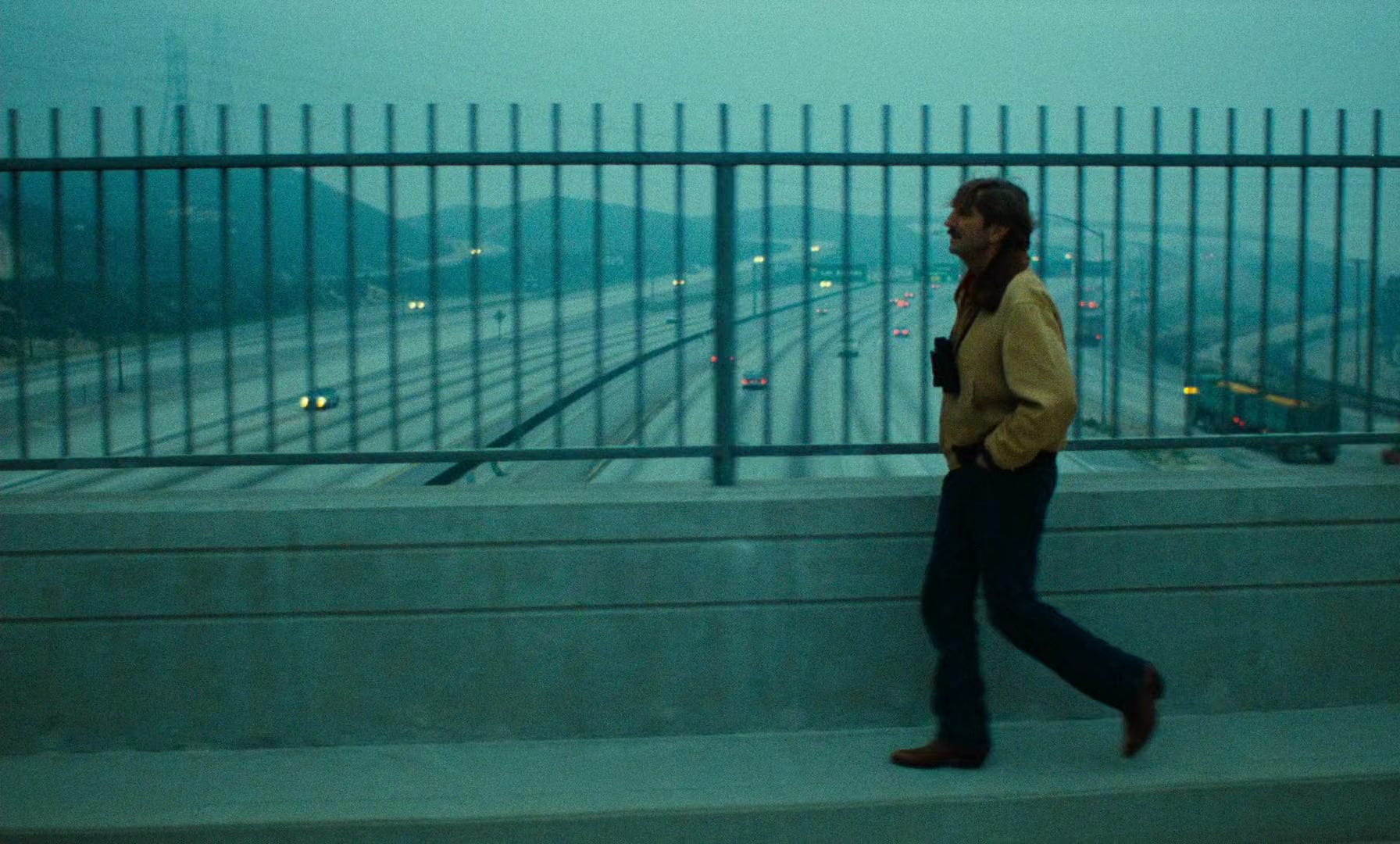
There is something inelegantly pastoral about it, notably not in keeping with the proud British heritage notion of the English countryside, but rather an overgrown, timeless quality that purposefully detaches itself from the modern world. Urban areas are few and far between, and getting from one place to the next requires long car journeys. And so, much of my young life was spent in the backseats of cars.
It’s something of a misconception to regard childhood as an endless playground of wasted time. School time is analogous to the adult preoccupation of work, and whatever other time you’ve got is filled with all manner of exciting distractions. But, in the quiet meditative comfort of long car journeys, young minds roam free.
I remember the sorry sight of some of the cars I rode in, grubby red-and orange nylon upholstery worn and cracked from decades of travellers, dog-eared roadmaps shoved in the front seat pocket, pastry crumbs and pennies in the front compartments, tatty cassettes crowding the glovebox.
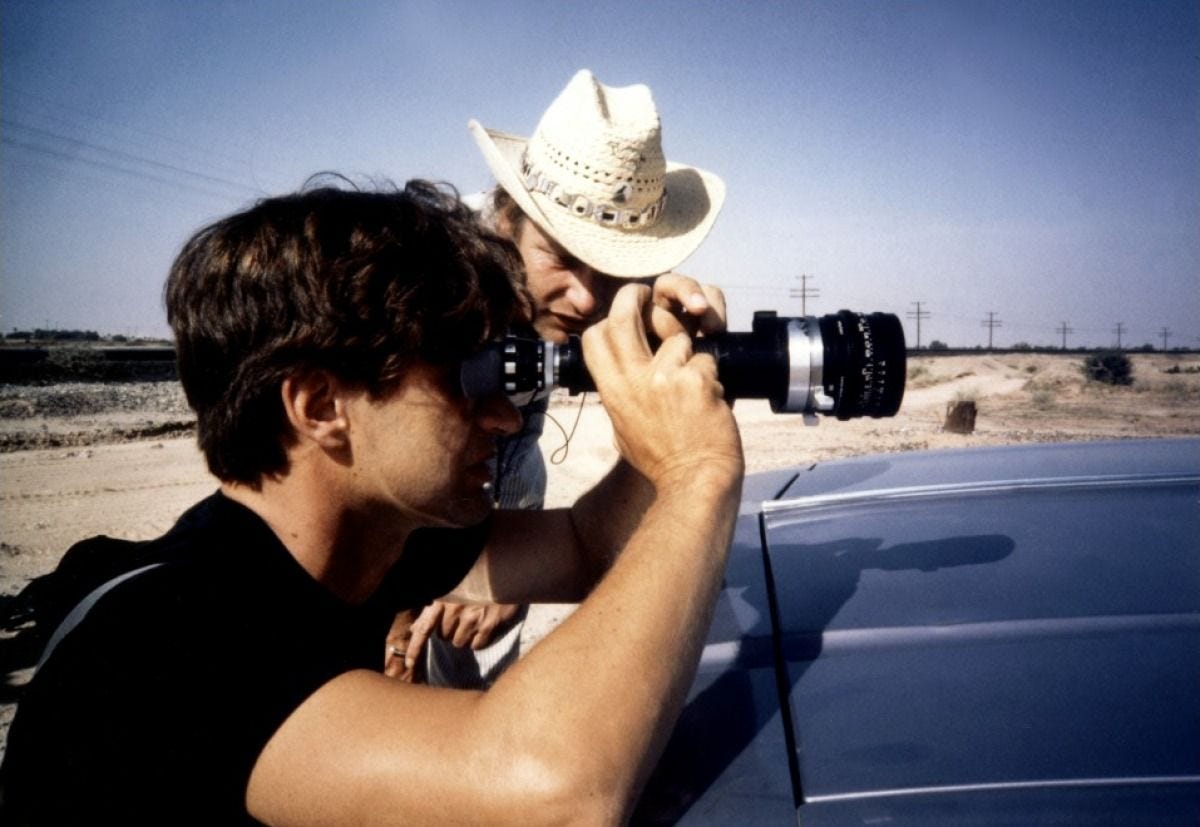
Wim Wenders reportedly prepared for Paris, Texas by driving around Texas for two months in a rented car, taking still photos and listening to rockabilly on his tape deck. It’s no wonder, then, how easily he can conjure the ecosystem of a well-travelled car. Though it never featured on my own travels, a cassette of Ry Cooder’s 1982 Bop Til You Drop would not have been out of place in the glovebox.
From the backseat window, I would look out at the landscape. It was complete in its endlessness, striking out straight to the horizon. There were no hills or contours to dissuade it, and though the fields were clustered with dense woodland, you never lost sight of the distance which lay behind it. Whatever man-made mass stood in the fields - a corrugated iron barn or a red brick outhouse - were antiques, weathered throughout decades of growth and decay from the natural world around it.
I can remember riding along the motorway in the last hour of daylight, and seeing how the steady light of the sunset changed hues and character to all roadside features from one instant to the next. Trees and fencing formed a tight lattice that burned rapidly changing shadows across the road. Then the sun was gone, and left only a still blue remnant of twilight as hundreds of engines carried on below.
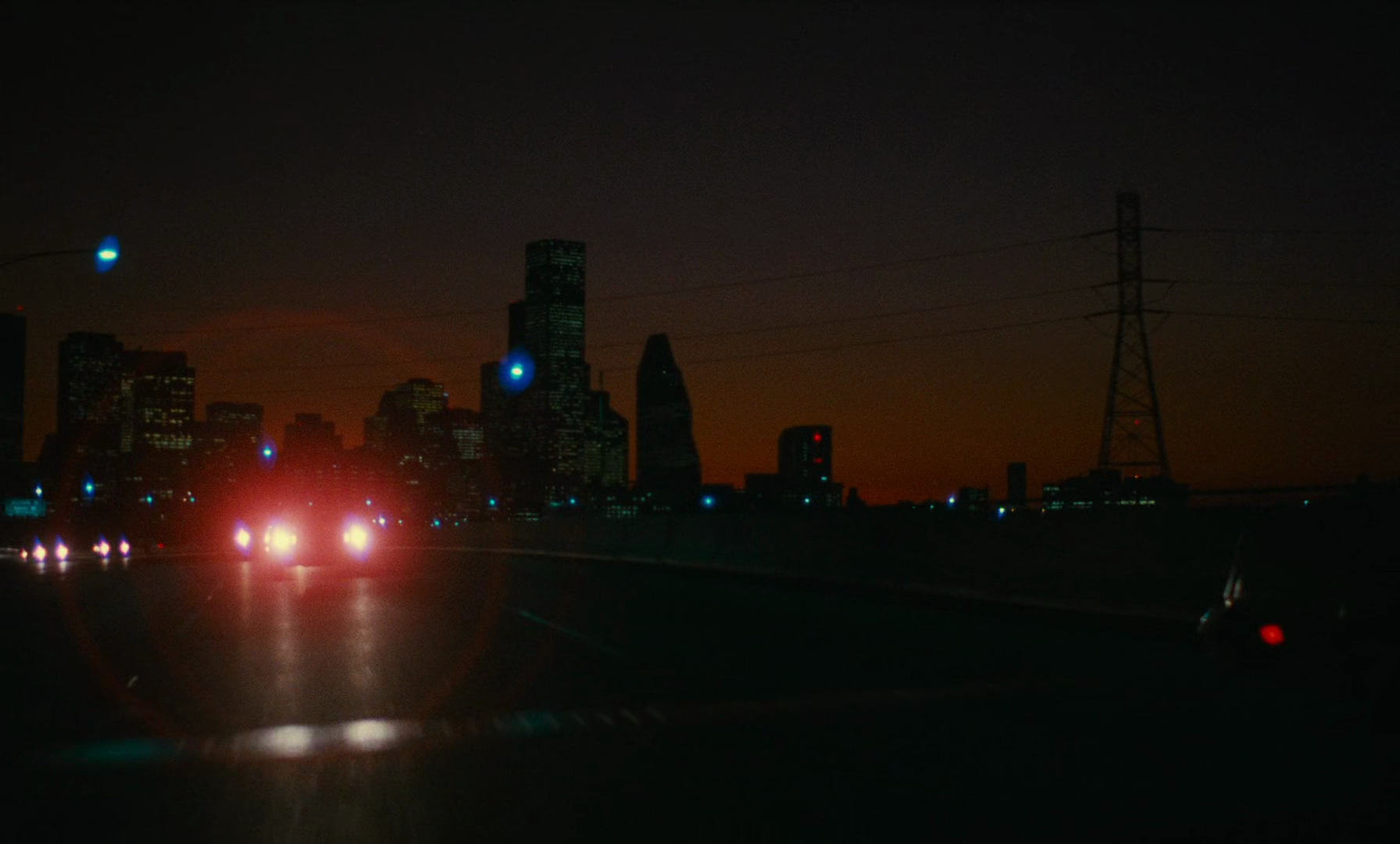
I can remember being drawn to every structure which stood undiscouraged by years of loneliness and emptiness, every aching iron bridge and lock which sutured along the rivers and canals, every long trail which led out to nowhere.
I wanted to stop on the roadside and walk to everything we passed, but I grew to learn that the true allure came from the brevity of witness; only by moving by could the desire of curiosity take hold. Like Travis, to remain too close to something for too long destroys the illusion we make of it in our minds, and the only safe constant is the motion of travel.
I can recall the large bungalows of elder relatives that sit nestled between wheat fields, far beyond paved roads or street lamps, far beyond the feign of civilization. On a quiet afternoon, I would stand silently in ornate bedrooms beside the open windows and listen to the low, ever-present surf of faraway traffic, reminding an anxious, displaced mind where it lay within the world beyond.
It was in these moments that I began to forge a private identity, a sense of self that orientated itself within ever-changing surroundings and thrived by the lull of rich bucolic sights passing by. For me, what remains the most deeply significant was the distance, looking for spectacle in sights that were miles beyond clarity, and trying to conceive the unimaginable potential for rich and varied lives that could be led elsewhere.
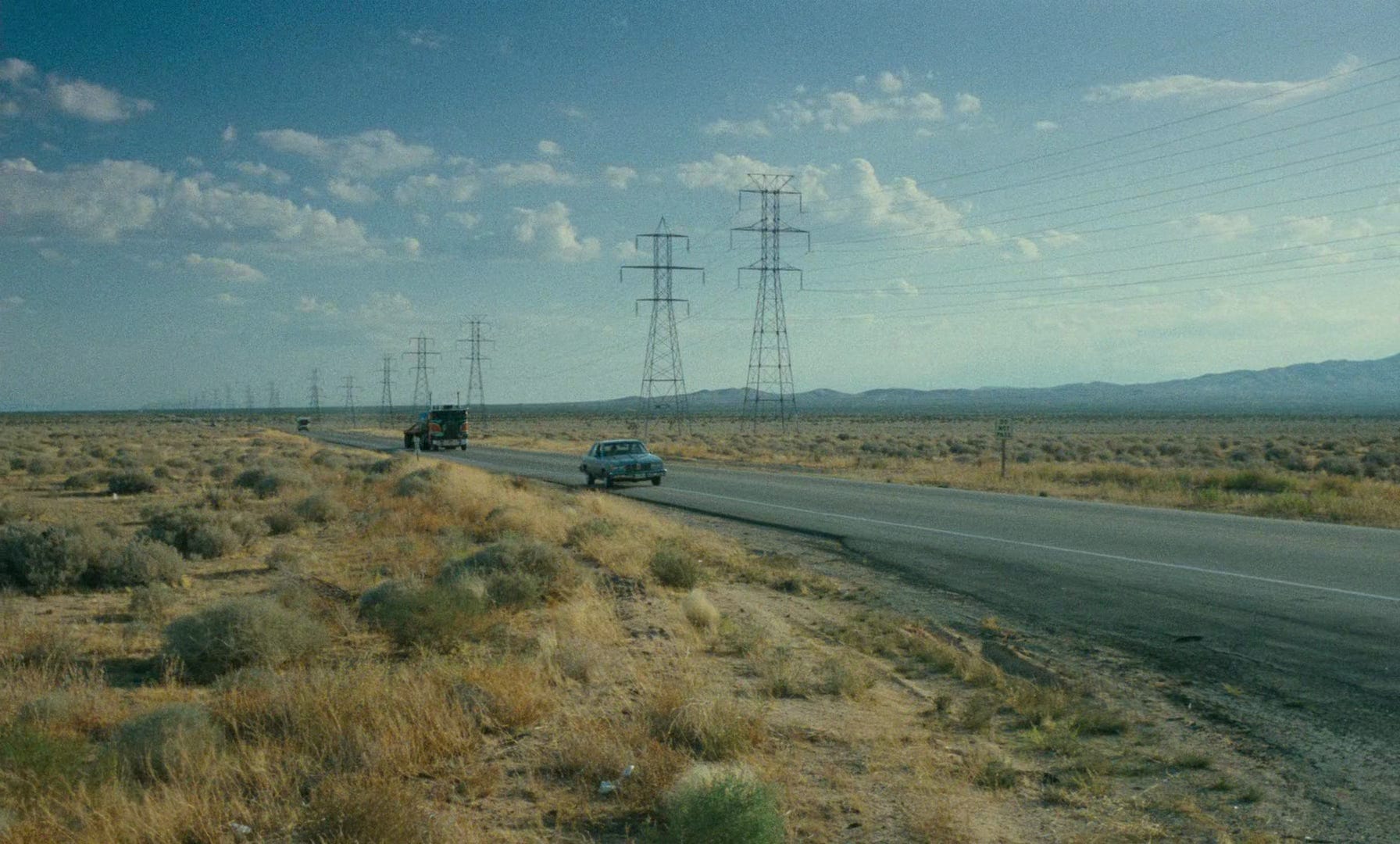
I think about these memories often, and, with a considerable perseverance of recollection, I can put myself there, remembering the sounds and sights with strong definition. But, if I want to feel what I felt in those moments; that overwhelming sense of the enormity of the world, of possibilities which lay far beyond my conception, I can only go to Paris, Texas. For, in the presence of that film, I feel truly seen in a way that I cannot be seen elsewhere.
It is a film which knows the tragedy and beauty of loneliness, a stillness that can properly soothe pains we cannot understand, let alone reconcile. It is an experience which does not demand that we come to it on its terms, but tries in earnest to move us on our own. It is the rarest of artworks: less an expression of a feeling, and more the feeling itself.
And within it lies a poignant universal truth: We are not always certain where we are going and cannot hold onto where we've been, but we somehow end up where we need to be.